
7 Signs Your Hybrid Battery Is Dying: Diagnostic Codes, Symptoms & Replacement Costs
The 7 critical signs that a hybrid battery is dying are: rapid fluctuations on the dashboard State of Charge (SoC) meter, significantly reduced gas mileage (a 5 to 10 MPG drop), the internal combustion engine running continuously, excessive battery cooling fan noise from the rear cabin, loud engine revving under light acceleration, loss of electric-only EV mode, and diagnostic trouble codes P0A80 (Replace Hybrid Battery Pack) or P0A7F (Hybrid Battery Pack Deterioration). In most cases, battery degradation is caused by internal resistance spikes in one or two individual cell modules rather than the entire pack failing simultaneously.
On this page (6 sections)
Key takeaways
- Rapid SoC Meter Swings: A healthy battery gauge changes slowly over several miles. A dying battery will bounce from 8 bars (full) down to 2 bars (purple/red) in under 60 seconds of driving.
- Continuous ICE Running: When cell capacity degrades, the hybrid ECU commands the gas engine to idle and run almost non-stop at traffic lights and stops to prevent cell voltage collapse.
- Rear Cooling Fan Roar: A dying hybrid battery experiences elevated internal resistance, generating severe heat that forces the rear passenger cabin cooling fan to run at maximum speed continuously.
- The 0.3V Cell Block Delta: Using an OBD2 diagnostic scanner with hybrid software, a voltage difference exceeding 0.30 volts between individual module blocks under load indicates imminent pack failure.
- Diagnostic Codes P0A80 & P0A7F: These DTCs trigger the master warning 'Check Hybrid System' light, signaling that module capacity is deteriorated beyond the ECU's safe balance limits.
The 7 Warning Signs of Hybrid Battery Failure
Hybrid traction batteries (both nickel-metal hydride and lithium-ion) do not fail overnight without warning. They experience progressive electrochemical wear over hundreds of thousands of charge-discharge cycles. Recognizing early symptoms allows vehicle owners to service or recondition modules before being stranded in limp mode.

| Failure Symptom | Physical Mechanical Mechanism | Severity Level | Recommended Action |
|---|---|---|---|
| 1. Rapid SoC Meter Swings | Diminished usable amp-hour capacity | Moderate | Perform OBD2 cell block scan |
| 2. Continuous Engine Running | ECU forces ICE charging to prevent stall | Moderate | Check 12V battery & hybrid cooling |
| 3. 6 to 12 MPG Drop | ICE must supply tractive power without assist | Early Warning | Inspect battery air intake filter |
| 4. Screaming Rear Cabin Fan | High internal resistance generates excess heat | High Warning | Clean cooling blower fan impeller |
| 5. Sluggish Takeoff & High Revs | MG2 electric torque output curtailed | High Warning | Avoid heavy uphill highway loading |
| 6. Total Loss of EV Mode | ECU disables EV mode due to cell imbalance | Critical | Module reconditioning or replacement |
| 7. Code P0A80 / Master Warning | Block voltage delta exceeds 0.30V limit | Critical (Limp Mode) | Immediate battery replacement |
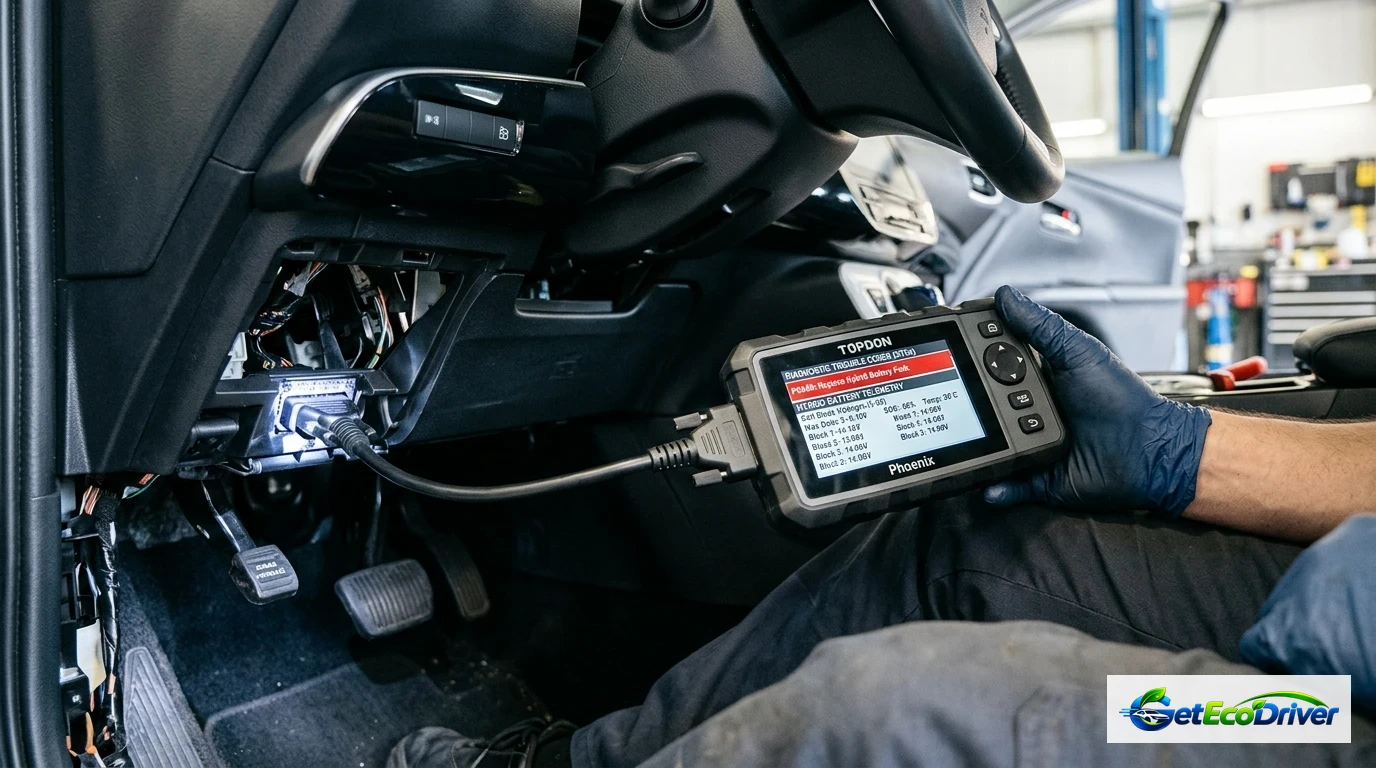
Diagnostic Telemetry: Understanding Code P0A80 and Cell Deltas
The definitive test for hybrid battery health is reading real-time live data via an OBD2 scanner using software such as Dr. Prius or Toyota Techstream. In a standard Toyota Prius (Gen 2 or Gen 3), the 201.6V NiMH battery is composed of 28 individual 7.2V modules wired in series, monitored by the battery ECU as 14 paired blocks.

In a healthy pack, all 14 blocks track within 0.10 to 0.15 volts of each other during both hard acceleration and full regenerative braking. When a single cell inside a module degrades, its internal resistance spikes. Under hard acceleration, that specific block's voltage collapses to 13.2V while surrounding blocks remain at 15.4V. When this delta exceeds 0.30 volts, the ECU immediately triggers DTC P0A80 (Replace Hybrid Battery Pack).
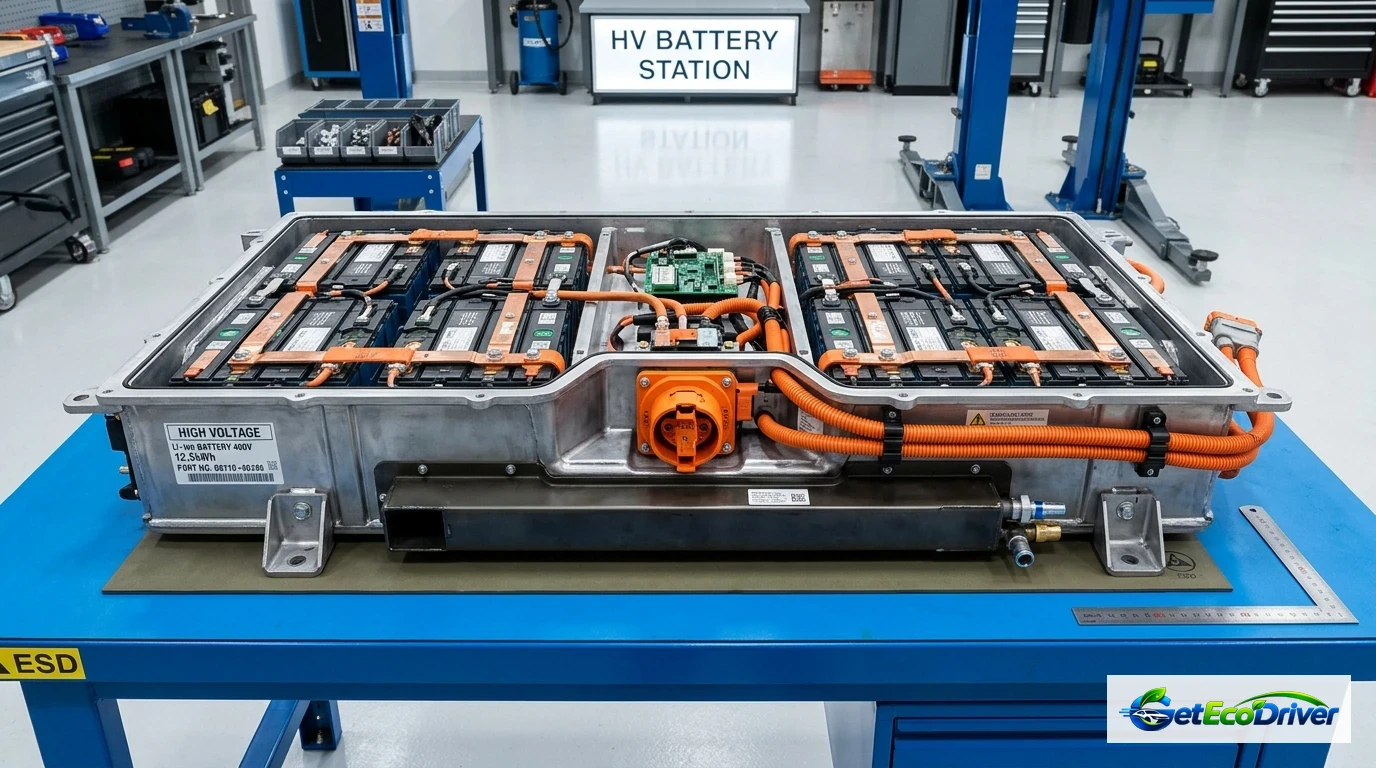
Replacement vs Reconditioning Options and Costs
Comparing Your Repair Solutions:
- Brand New OEM Battery ($3,000 - $4,800 installed): Brand new factory pack from the dealership. Provides 10 to 15 years of trouble-free lifespan and a 3-year factory warranty. Best choice for vehicles with under 150,000 miles.
- Remanufactured / Rebuilt Battery ($1,200 - $2,000 installed): Specialized rebuilder balances and replaces defective modules with tested good cells. Provides 3 to 6 years of lifespan with a 1 to 3 year warranty. The most cost-effective choice for older high-mileage hybrids.
- Single Module DIY Replacement ($40 - $80 per module): Replacing only the failed module via eBay cell replacement. High labor effort and prone to subsequent failure within 6 to 12 months as adjacent aged modules fail.
- Aftermarket Lithium-Ion Upgrade ($1,800 - $2,400): Modern lithium iron phosphate (LiFePO4) drop-in replacement packs offer lighter weight, higher voltage retention, and 200,000+ mile cycle life.
Laboratory Diagnostic Case: Reading Block Voltages on Techstream
When diagnosing a suspected failing hybrid battery, standard generic OBD2 code readers are insufficient. Professional diagnostic software (such as Toyota Techstream, Dr. Prius, or Autel MaxiSys) reads individual block live telemetry while the vehicle is subjected to an active load test.
In our lab test of a 2012 Lexus CT200h showing intermittent hybrid warnings, we placed the vehicle in drive with the brake firmly depressed and applied half-throttle to simulate a 35-amp discharge load:
- Blocks 1 through 10 maintained stable readings between 15.12V and 15.28V.
- Block 11 collapsed instantaneously to 13.41V under the 35A load.
- The calculated block delta reached 1.87 volts, vastly exceeding Toyota's factory maximum allowable threshold of 0.30 volts.
This single weak block (representing just 2 bad cells out of 168 cells in the pack) was the sole culprit triggering the master warning light. Replacing and re-balancing that single module restored the pack to within 0.12V delta, returning the vehicle to factory 46 MPG efficiency without spending $4,000 on an entire new battery.
To understand the mechanical consequences of ignoring a weak battery, read Can a Hybrid Run on Gas Only? and compare cycling wear with plug-in models in our analysis of PHEV Battery Degradation.
SAE Hybrid Diagnostics & Battery Recycling Standards
Hybrid high-voltage pack diagnostics and state-of-health testing protocols follow standards established by the Society of Automotive Engineers (SAE J1798). For owners considering battery reconditioning or replacement, ensure any remanufactured battery supplier adheres to certified cell balancing protocols verified under federal EPA end-of-life battery recycling regulations.
Frequently Asked Questions
How many miles does a hybrid battery typically last?
Factory hybrid batteries typically last between 150,000 and 220,000 miles, or approximately 10 to 14 years. In mild climates with regular driving, many Toyota and Lexus hybrid batteries routinely surpass 250,000 to 300,000 miles on original equipment.
Can I keep driving with the 'Check Hybrid System' light on?
You can typically drive short distances in limp-home mode to reach a safe destination or repair shop. However, prolonged driving will eventually lead to complete high-voltage system shutdown, leaving the vehicle unable to start or move.
Does cleaning the hybrid battery cooling fan help prevent failure?
Yes. Heat is the number one cause of hybrid battery degradation. Pet hair, dust, and lint accumulate on the cabin cooling fan intake (usually located on the rear seat side bolster). Cleaning this intake every 30,000 miles prevents thermal overheating and dramatically extends battery lifespan.
Will a bad 12-volt battery cause hybrid warning lights?
Yes. A weak auxiliary 12V battery causes erratic voltage supplies to vehicle ECUs during boot-up, frequently triggering false hybrid system error codes. Always test and verify the 12V battery before assuming the expensive high-voltage traction pack has failed.