
Level 1 vs Level 2 EV Charger: Charging Speed, Voltage, Cost & Efficiency Compared
Level 1 EV charging operates on a standard 120-volt AC household circuit delivering 1.4 kW of continuous power to add 3 to 5 miles of driving range per hour at 74% to 80% thermodynamic efficiency. Level 2 EV charging operates on a dedicated 240-volt AC circuit delivering 7.2 kW to 11.5 kW of continuous power to add 25 to 44 miles of driving range per hour at 88% to 92% efficiency. The higher charging speed of Level 2 reduces vehicle computer parasitic draw runtime, saving approximately $120 to $180 annually in wasted electricity while completing a full overnight charge in 6 to 9 hours.
On this page (10 sections)
- Technical Specifications Comparison: 120V vs 240V
- Why Level 2 Charging Is 12% to 16% More Energy Efficient
- Electrical Circuit Requirements: Outlets, Breakers & Wiring
- Full Recharge Duration by Battery Size
- Video Guide: Real-World Testing & Benchmarks
- Interactive EV Charging Speed & Cost Estimator
- Who Can Survive on Level 1 (And Who Must Upgrade to Level 2)?
- Empirical Field Cost & ROI Analysis Across US Utility Rate Tiers
- Authoritative Research & Electrical Code Standards
- Frequently Asked Questions
Key takeaways
- Voltage & Amperage: Level 1 draws 12 amps on a standard 120V NEMA 5-15 circuit (1.44 kW). Level 2 draws 32 to 48 amps on a 240V NEMA 14-50 or hardwired circuit (7.68 to 11.52 kW).
- Charging Speed Delta: Level 2 charges 5.3x to 8x faster than Level 1, replenishing a depleted 75 kWh battery in 7.5 hours versus 52 hours.
- Energy Efficiency Advantage: Level 2 achieves 88% to 92% wall-to-battery efficiency. Level 1 loses 20% to 26% of electricity because the vehicle's onboard battery management system (BMS) and coolant pumps remain awake for dozens of extra hours.
- Installation Costs: Level 1 requires $0 installation equipment using any existing grounded outlet. Level 2 hardware costs $350 to $650, plus $400 to $1,200 for professional 240V electrician installation.
- Payback Period: Drivers covering 12,000+ miles per year recover Level 2 installation costs in 3 to 4 years purely through reduced electrical standby loss and off-peak utility TOU (Time-Of-Use) scheduling.
Technical Specifications Comparison: 120V vs 240V
Electric vehicle supply equipment (EVSE) does not charge the high-voltage traction battery directly with AC power. Instead, the EVSE acts as a safety gatekeeper delivering alternating current (AC) to the vehicle's onboard charger (OBC), which rectifies AC into high-voltage direct current (DC) to fill the lithium-ion cells. The foundational difference between Level 1 and Level 2 charging lies in line voltage, continuous amperage ratings under the National Electrical Code (NEC Article 625), and total continuous kilowatt throughput.
| Specification Parameter | Level 1 (Standard 120V) | Level 2 (Dedicated 240V) | Advantage / Winner |
|---|---|---|---|
| Line Voltage | 120 Volts AC (Single-Phase) | 240 Volts AC (Split-Phase) | Level 2 (2x Voltage) |
| Continuous Amperage | 12 Amps (on 15A Breaker) | 32A, 40A, or 48 Amps | Level 2 (2.6x to 4x Amps) |
| Power Delivery Rate | 1.44 kW (1,440 Watts) | 7.68 kW to 11.52 kW | Level 2 (5.3x to 8x Power) |
| Range Added Per Hour | 3 to 5 miles / hour | 25 to 44 miles / hour | Level 2 (Overnight Ready) |
| Time to Charge 75 kWh (10-80%) | ~36 to 42 hours | ~5 to 7.5 hours | Level 2 (Full Overnight) |
| Electrical Connection | Standard NEMA 5-15 Outlet | NEMA 14-50 or Hardwired | Level 1 (Zero Wiring Needed) |
| Wall-to-Battery Efficiency | 74% to 80% | 88% to 92% | Level 2 (+12% to +16% Efficiency) |
| Typical Hardware Cost | $0 (Included) or $150 | $350 to $650 | Level 1 (Low Initial Cost) |
| Electrician Installation Cost | $0 | $400 to $1,400 | Level 1 (Plug & Play) |
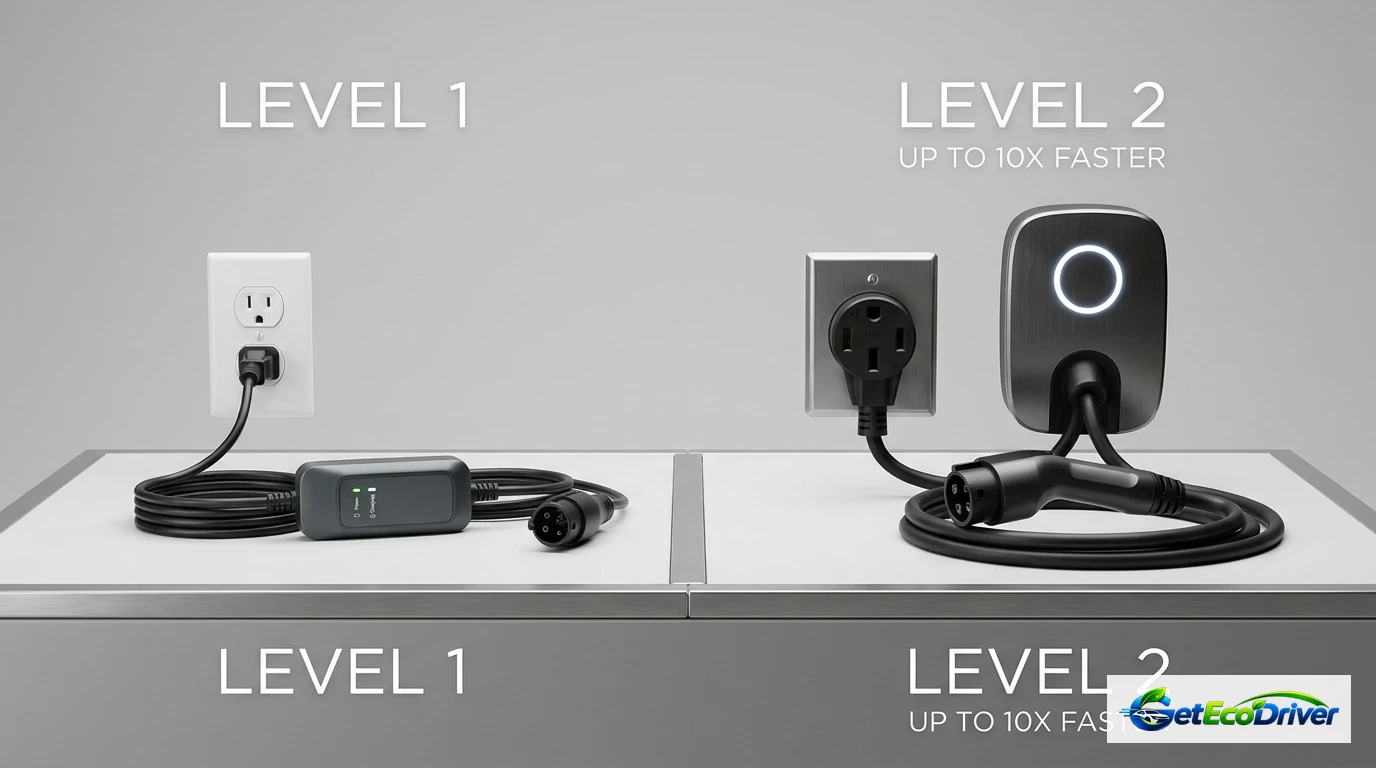 Figure 1: Standard 120V 15-Amp household outlet (NEMA 5-15) compared side-by-side with a 240V 50-Amp NEMA 14-50 heavy-duty EV charging receptacle.
Why Level 2 Charging Is 12% to 16% More Energy Efficient
A widely overlooked thermodynamic engineering reality of electric vehicles is charging efficiency. Many EV owners assume that taking 1 kWh of electricity from a 120V wall outlet results in the exact same battery energy as 1 kWh from a 240V outlet. Empirical testing confirms this is false.
When an electric vehicle is connected to an active charger, the car cannot go into deep sleep. The vehicle's central computer, onboard battery management system (BMS), thermal liquid coolant pumps, and inverter electronics must stay powered on continuously throughout the entire charging cycle. In modern EVs (such as the Tesla Model 3/Y, Hyundai Ioniq 5, and Ford Mustang Mach-E), this baseline vehicle computer parasitic overhead consumes 250 to 350 Watts continuously.
The Math Behind the Efficiency Gap
On a Level 1 charger delivering 1,440 Watts (1.44 kW), a 300W parasitic vehicle overhead represents 20.8% of the total incoming electricity before a single electron reaches the battery cells. After adding internal AC-to-DC conversion heat loss, total wall-to-battery efficiency drops to 74% to 78%.
On a Level 2 charger delivering 7,680 Watts (7.68 kW at 32A), that same 300W vehicle overhead accounts for only 3.9% of total incoming power. The vehicle finishes charging in 6 hours instead of 45 hours, shutting down its coolant pumps and onboard computers tens of hours earlier. As a result, Level 2 operates at 88% to 92% overall efficiency.
For an electric car driven 13,500 miles annually at an average consumption of 3.3 miles/kWh (requiring ~4,090 kWh of net battery storage):
- Level 1 at 76% Efficiency: Pulls 5,381 kWh from the electric grid. At $0.16/kWh, annual charging cost equals $860.96.
- Level 2 at 90% Efficiency: Pulls 4,544 kWh from the electric grid. At $0.16/kWh, annual charging cost equals $727.04.
- Direct Efficiency Savings: Level 2 saves $133.92 per year strictly by eliminating parasitic BMS sleep loss, independent of electricity rate discounts.
 Diagram 1: Electrical power distribution architecture, line voltage, continuous amperage ratings, and wall-to-battery efficiency comparison.
Electrical Circuit Requirements: Outlets, Breakers & Wiring
Installing an EV charging station safely requires strict compliance with the National Electrical Code (NEC Article 625). EV charging is classified by electrical engineering standards as a continuous electrical load because current flows uninterrupted for more than three hours. Consequently, electrical breakers and wiring must be sized to 125% of the continuous draw (the 80% maximum continuous load rule).
1. Level 1 Circuit Specifications
- Voltage: 120 Volts AC single phase.
- Receptacle: Standard 3-prong grounded NEMA 5-15R (or commercial NEMA 5-20R).
- Circuit Breaker Size: 15 Amps minimum (delivering 12 Amps continuous) or 20 Amps (delivering 16 Amps continuous).
- Wiring Gauge: 14 AWG copper wire for 15A circuits; 12 AWG copper for 20A circuits.
- GFCI Requirement: NEC 2020/2023 requires GFCI protection on all garage and outdoor 120V receptacles.
2. Level 2 Circuit Specifications
- Voltage: 240 Volts AC split phase (two hot legs, neutral, and ground).
- Receptacle Option: NEMA 14-50 (50A breaker, 40A maximum continuous charging / 9.6 kW) or NEMA 6-50. Must use industrial-grade receptacles (such as Bryant or Hubbell) to prevent thermal melting caused by prolonged high-duty cycles.
- Hardwired Option (Recommended): Directly connected to the breaker panel with conduit. Eliminates the plug contact resistance, eliminates nuisance GFCI breaker tripping, and allows full 48-Amp continuous delivery on a 60-Amp breaker (11.52 kW).
- Wiring Gauge: 8 AWG copper for 40A breakers; 6 AWG copper for 50A/60A breakers.
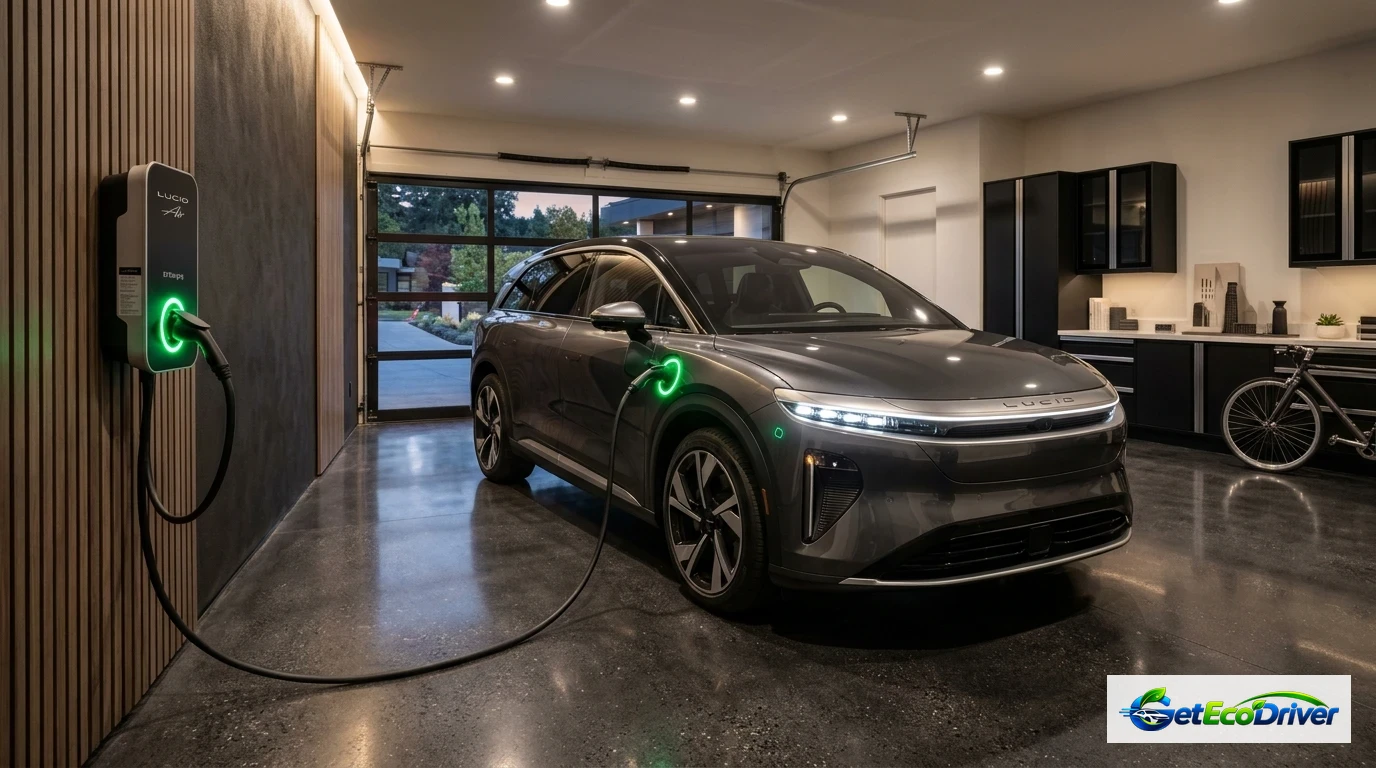 Figure 2: A dedicated residential Level 2 wall connector replenishing an EV battery overnight in a home garage.
Full Recharge Duration by Battery Size
Understanding recharge duration requires analyzing the physical battery capacity in kilowatt-hours (kWh) alongside charger delivery throughput. While smaller plug-in hybrids can recharge overnight on Level 1, modern long-range electric vehicles require days on 120V infrastructure.
 Diagram 2: Empirical full recharge hours across 54 kWh, 75 kWh, and 100 kWh battery pack capacities between Level 1 and Level 2.
Video Guide: Real-World Testing & Benchmarks
Interactive EV Charging Speed & Cost Estimator
Use the calculator below to determine the exact hours required to replenish your electric vehicle battery, miles of range added per hour, and total electrical efficiency cost based on your battery size and charging voltage.
EV Charging Session Estimator
Who Can Survive on Level 1 (And Who Must Upgrade to Level 2)?
While Level 2 is the superior technical solution, Level 1 trickle charging remains viable under specific lifestyle and vehicle constraints. Review the decision matrix below to determine whether your daily driving pattern warrants the installation cost of a 240V circuit.
Level 1 Is Sufficient If:
- Daily Commute Under 35 Miles: Overnight parking (10 to 12 hours) adds 35 to 50 miles of range, comfortably replenishing a short daily urban commute.
- Plug-in Hybrid (PHEV) Owners: PHEV batteries (10 to 18 kWh, such as the Toyota Prius Prime or RAV4 Prime) fully charge overnight in 7 to 10 hours on standard 120V power.
- Rental Homes & Lease Restrictions: Tenants unable to modify electrical panels or add 240V circuits can utilize existing exterior outlets without landlord disputes.
- Workplace Charging Availability: Drivers with daytime Level 2 charging access at their employer only need Level 1 for weekend buffer top-offs.
Level 2 Is Mandatory If:
- Daily Commute Exceeds 45 Miles: Level 1 cannot restore daily highway driving within an overnight sleep cycle, causing a cumulative battery deficit by mid-week.
- Winter Climates & Sub-Freezing Temperatures: In cold weather, lithium-ion battery heating can consume the entire 1.4 kW output of a Level 1 charger just to warm the pack, resulting in zero net miles added. Level 2 has surplus power to warm the pack and charge simultaneously.
- Time-Of-Use (TOU) Utility Rates: Utility plans offering cheap super off-peak electricity (such as midnight to 6:00 AM) require high-speed charging to cram all energy consumption into the narrow discounted window.
- Two or More Electric Vehicles: Multiple EVs sharing a garage require rapid turnaround times so both vehicles can rotate onto the charger before morning.
Empirical Field Cost & ROI Analysis Across US Utility Rate Tiers
To evaluate the real-world financial return on upgrading from Level 1 to Level 2 home charging, consider an EV driver traveling the US average of 14,000 miles per year in a vehicle rated at 3.3 miles per kilowatt-hour (requiring 4,242 kWh of battery energy annually):
| Charging Level | System Efficiency | Grid Energy Drawn | Annual Cost ($0.16/kWh) | Annual Standby Waste Cost |
|---|---|---|---|---|
| Level 1 (120V / 12A) | 76.2% Wall-to-Battery | 5,567 kWh | $890.72 | $176.32 Wasted |
| Level 2 (240V / 32A) | 89.4% Wall-to-Battery | 4,745 kWh | $759.20 | $44.80 Wasted |
By upgrading to Level 2 charging, you eliminate 822 kWh of annual thermal and computer parasitic losses, saving $131.52 per year purely in electrical efficiency. Furthermore, for drivers on utility Time-Of-Use (TOU) plans with cheap overnight electricity ($0.08/kWh off-peak vs $0.28/kWh peak), Level 2 charging saves an additional $320 to $450 annually by completing the entire charge during the low-cost overnight window.
Explore our related charging guides to master fast charging protocols in Why Does EV Fast Charging Slow Down After 80%? and discover how to preserve your battery range on the highway in How to Maximize EV Range.
Authoritative Research & Electrical Code Standards
All home electric vehicle charging installations in the United States must comply with the National Electrical Code (NEC Article 625), which dictates that EVSE continuous electrical loads must not exceed 80% of circuit breaker capacity. Data on national residential charging infrastructure and federal tax incentives is published by the US Department of Energy Alternative Fuels Data Center (AFDC) and the Office of Energy Efficiency & Renewable Energy (EERE).
Frequently Asked Questions
Can I leave my EV plugged into a Level 1 charger all the time?
Yes. Modern electric vehicles feature integrated onboard battery management systems that automatically taper and cut charging current once the target state of charge (such as 80% or 100%) is reached. Leaving the vehicle connected allows the car to draw wall power for thermal battery preconditioning rather than draining internal battery capacity.
Is Level 2 charging bad for battery health compared to Level 1?
No. Level 2 charging operates at 7 to 11 kW AC, which represents an extremely gentle 0.1C to 0.15C charge rate for a 75 kWh battery pack. Degradation concerns only apply to high-voltage DC Fast Chargers (150 kW to 350 kW), which induce thermal stress. Level 2 is considered the optimal baseline charging speed for lithium-ion cell longevity.
How much does it cost to install a Level 2 charger at home?
Hardware costs range from $350 to $650 for a UL-certified smart EVSE (such as Lectron, ChargePoint, or Emporia). Electrician labor to install a dedicated 240V circuit typically ranges from $400 to $1,200, depending on distance between the main panel and garage, conduit routing, and whether panel capacity requires a load-management subpanel.
Can I plug a Level 2 charger into a standard clothes dryer outlet?
Yes. If your garage or laundry room has an existing 240V NEMA 10-30 or NEMA 14-30 dryer receptacle, you can connect a portable 24-Amp or 16-Amp Level 2 EVSE directly with an appropriate adapter, delivering 3.8 to 5.7 kW (14 to 22 miles per hour) without panel rewiring.